
Ireland is entering one of the most ambitious periods of construction and infrastructure investment in its modern history. From underground rail and strategic motorway links to housing infrastructure, renewable energy connections and a new generation of data centres, the projects moving through Ireland’s pipeline have the potential to reshape how the country lives, travels and does business.
The scale of the opportunity is difficult to ignore. Ireland’s updated National Development Plan provides for €275.4 billion of investment between 2026 and 2035. It includes a target of 300,000 new homes, alongside major spending on transport, energy, water and other essential public infrastructure. However, announcing investment is the easy part. Delivering several complex programmes at the same time is considerably harder.
Ireland must now answer two practical questions. Where will the construction industry obtain the materials required to build at this scale? More importantly, where will companies find enough qualified people to turn plans, permissions and budgets into completed projects?

MetroLink moves from a long-term ambition towards delivery
Few projects symbolise Ireland’s infrastructure ambitions more clearly than MetroLink. Planning approval for the Railway Order was granted in September 2025, while the related judicial review was resolved before the end of that year. This has allowed the programme to move into procurement and early delivery activity.
The planned route will run for approximately 19 kilometres between Swords and Charlemont, serving Dublin Airport, Ballymun, Glasnevin and the city centre. It will include 16 stations and is expected to carry up to 20,000 passengers per hour in each direction. According to the project’s supplier information, the system could serve up to 53 million passengers annually.
MetroLink is not simply a rail project. It will require tunnelling expertise, major civil engineering, station construction, utility diversions, electrical systems, signalling, ventilation, fire protection, communications infrastructure and extensive public-realm works. It will create demand for experienced project managers, tunnelling specialists, civil and structural engineers, quantity surveyors, BIM professionals, electricians, mechanical tradespeople and health and safety personnel.
Its wider value will come from the development it can support. Better links between Dublin Airport, the city centre and rapidly growing communities in north Dublin can make housing land more viable, improve access to employment and reduce the economic cost of congestion. MetroLink’s own supplier guide estimates that it could unlock planning potential across almost 9,500 hectares within 2.5 kilometres of its stations.
New roads will strengthen regional and commercial links
Outside Dublin, several major road projects are already creating significant construction demand.
Construction of the €456 million M28 Cork to Ringaskiddy project is under way. The scheme includes 11 kilometres of motorway between the Bloomfield Interchange and Barnahely, together with a relief road serving Ringaskiddy. Completion is expected in summer 2028.
The project is important for more than journey times. Ringaskiddy is one of Ireland’s most strategically important port and industrial locations. Improved access can make freight movements more reliable, support the Port of Cork and strengthen the wider pharmaceutical, life sciences and manufacturing cluster in the region.
In Limerick, the Adare Bypass is another significant project under construction. Approximately €150 million is being invested in the bypass, with completion targeted for summer 2027. It forms part of the wider Foynes to Limerick road scheme, which is intended to improve freight access from Foynes Port while reducing congestion through Adare.
Further projects remain in the development pipeline, including the N/M20 Cork to Limerick scheme. Progress on these routes will be vital if Ireland wants investment and employment growth to extend beyond Dublin. Regional cities cannot reach their full potential without faster, safer connections between ports, industrial zones, housing areas and labour markets.
Housing requires much more than housebuilders
Ireland’s housing targets will create another major stream of work, although the pressure will not fall on residential contractors alone.
The Government’s €1 billion Housing Infrastructure Investment Fund approved an initial group of 82 projects in June 2026, with the potential to unlock land capable of accommodating more than 200,000 homes. These projects include the roads, water services, drainage systems and other enabling works without which housing cannot proceed.
This distinction matters. Ireland does not simply need more bricklayers and carpenters. It needs civil engineers, pipe layers, plant operators, utility specialists, surveyors, planners, electricians and project managers capable of preparing entire communities for development. New homes also generate demand for schools, healthcare facilities, transport links and local amenities.
If housing delivery accelerates without equivalent investment in these supporting systems, bottlenecks will simply move from one stage of development to another.
Energy infrastructure is becoming construction infrastructure
Ireland’s construction pipeline is increasingly tied to the transformation of its electricity system.
The Celtic Interconnector, being developed by EirGrid and its French counterpart RTE, will create Ireland’s first direct electricity connection with continental Europe. Construction began in 2023, with substantial onshore work taking place in east Cork. The 700MW connection will improve Ireland’s ability to import or export electricity, support renewable generation and strengthen energy security.
The country will also require new substations, transmission lines, offshore connections and energy-storage facilities to accommodate renewable power. These are highly specialised projects. They create demand for high-voltage engineers, cable jointers, commissioning engineers, electrical technicians, welders, marine specialists and workers experienced in constructing substations and grid infrastructure.
This energy build-out is also inseparable from the next wave of Irish data centre construction.
Ireland’s next generation of data centres
Data centres remain among the largest and most technically demanding projects in the Irish commercial construction market.
In March 2026, Equinix announced that construction had begun on DB7x, a new high-performance data centre in Blanchardstown. The company expects to invest $78 million in the facility, with a further $14 million supporting its retail data centre fit-out. Capacity is scheduled to become available from early 2028. The development is being built on an existing Equinix site and will use power already allocated there, meaning it will not require additional grid capacity.
In Wicklow, Echelon Data Centres has announced a much larger programme across its DUB20 and DUB30 campuses in Arklow. The company estimates that €3.5 billion will be invested across the two sites. DUB20 is being developed at the former Irish Fertilisers Industries site in the Avoca River Business Park, while DUB30 is planned for Kish Business Park.
Echelon has projected that the two developments will support approximately 2,600 construction jobs and 715 permanent roles once operational. A company-commissioned economic assessment by KPMG estimated an economic impact of €7.5 billion during construction, followed by approximately €801 million each year once both campuses are operating.
Those figures demonstrate the potential scale of data centre investment, but they do not remove the need for scrutiny. Data centres accounted for 22% of Ireland’s electricity demand in 2024. The Commission for Regulation of Utilities expects their share to reach 31% by 2034 on the basis of currently contracted demand.
New connection rules now require data centre developers to provide generation or storage capacity matching their requested maximum import demand. They must also meet at least 80% of their annual electricity requirement through additional renewable projects in Ireland, subject to a six-year development period.
This represents a more credible model for future development. Data centres can support Ireland’s position in cloud computing, artificial intelligence and foreign direct investment. They can also provide long-term customers for renewable energy projects. However, their economic case will be strongest when developers contribute to new generation, grid resilience and regional employment rather than competing with homes and existing businesses for constrained electricity capacity.
Can Ireland obtain the materials it needs?
Material cost inflation has eased from the extreme levels experienced after the pandemic and the invasion of Ukraine. The Society of Chartered Surveyors Ireland reported that commercial tender prices rose by 2.5% during 2025, the lowest annual increase since 2020.
That does not mean the supply-chain challenge has disappeared. Almost six in ten surveyors responding to the SCSI’s early 2026 research believed material prices were either in a mid-upswing or at their peak. Most expected tender prices to increase again during the first half of 2026.
The challenge is especially acute for simultaneous, technically complex projects. Data centres, rail systems, renewable energy developments and major industrial facilities often require many of the same products. These include structural steel, reinforcement, precast concrete, cable, transformers, switchgear, backup generation, cooling systems and other mechanical and electrical equipment.
Many of these items have long manufacturing lead times and limited global supplier capacity. An electrical package ordered too late can delay an otherwise completed facility by months.
Companies will need to identify critical materials much earlier in the design process. Framework agreements, dual sourcing and direct relationships with manufacturers can reduce exposure to shortages. Standardising designs across multiple buildings can also create purchasing power while making off-site manufacturing more practical.
Modern methods of construction should form part of the response. Prefabricated service modules, precast components and factory-built plant rooms can reduce activity on crowded sites, improve quality control and use scarce labour more efficiently. They cannot remove the need for skilled workers, but they can ensure those workers spend less time on repetitive tasks that can be completed safely in a controlled environment.
The larger problem is manpower
Ireland cannot deliver this pipeline by moving the same limited group of workers from one project to another.
SOLAS has estimated that between 68,000 and 80,000 additional construction workers could be required by 2030 for housing and retrofitting alone. A more recent Property Industry Ireland assessment puts the requirement at around 100,000 additional roles when wider infrastructure ambitions are included.
The shortages extend across nearly every level of the industry. Ireland needs civil engineers, construction managers, quantity surveyors, site engineers, CAD and BIM technicians, electricians, plumbers and specialist trades. Mission-critical projects add demand for commissioning engineers, controls specialists, pipefitters, welders, high-voltage personnel and people with experience in data centre cooling and power systems.
Expanding apprenticeships is essential, but an apprentice beginning today cannot immediately fill a senior role requiring ten years of project experience. Ireland must therefore work across several timelines at once.
The domestic workforce should be expanded through apprenticeships, graduate development, return-to-work programmes and greater participation by women. Experienced Irish construction professionals working overseas should be given clear reasons to return, including visible project timelines and credible long-term career opportunities.
Companies must also improve productivity through digital planning, better scheduling and modern construction methods. Most importantly, employers need to accept that international recruitment will remain a necessary part of workforce planning.
Recruiting from overseas cannot be treated as an emergency measure introduced after a project has already fallen behind. Employers need accurate forecasts for each stage of construction, followed by early recruitment for the occupations that cannot be filled locally. Qualifications and practical ability must be verified before mobilisation. Employment permits, relocation, accommodation and integration support also need to be planned as part of project delivery.
For specialist trades, practical testing is particularly valuable. A CV may state that someone is an experienced welder, electrician, fabricator or mechanical technician, but a structured skills assessment provides much stronger evidence that the person can work safely and productively to the required standard.
What could this construction wave mean for Ireland’s economy?
If Ireland delivers these projects successfully, the economic benefits will extend far beyond the value of the construction contracts.
During construction, investment supports employment, wages and demand throughout local supply chains. Engineering consultancies, equipment suppliers, transport operators, accommodation providers and small subcontractors all benefit from activity on major sites.
The completed assets can create much greater long-term value. MetroLink can improve access to employment and development land. The M28 can strengthen the Port of Cork and its industrial hinterland. The Adare Bypass and wider Foynes connection can improve regional freight movement. New energy infrastructure can make Ireland more resilient, while responsibly developed data centres can reinforce the country’s position as a location for technology investment.
There are risks, however. If every project competes for the same engineers, electricians and materials without coordination, costs will rise while schedules slip. Large projects may draw workers away from housing or smaller regional developments. An influx of workers without adequate accommodation could place further pressure on already constrained rental markets.
The real economic prize will therefore come from increasing Ireland’s total delivery capacity, not merely redirecting it. That means training more people, attracting experienced international professionals, expanding the supply chain and giving contractors enough certainty to invest in equipment, technology and permanent teams.
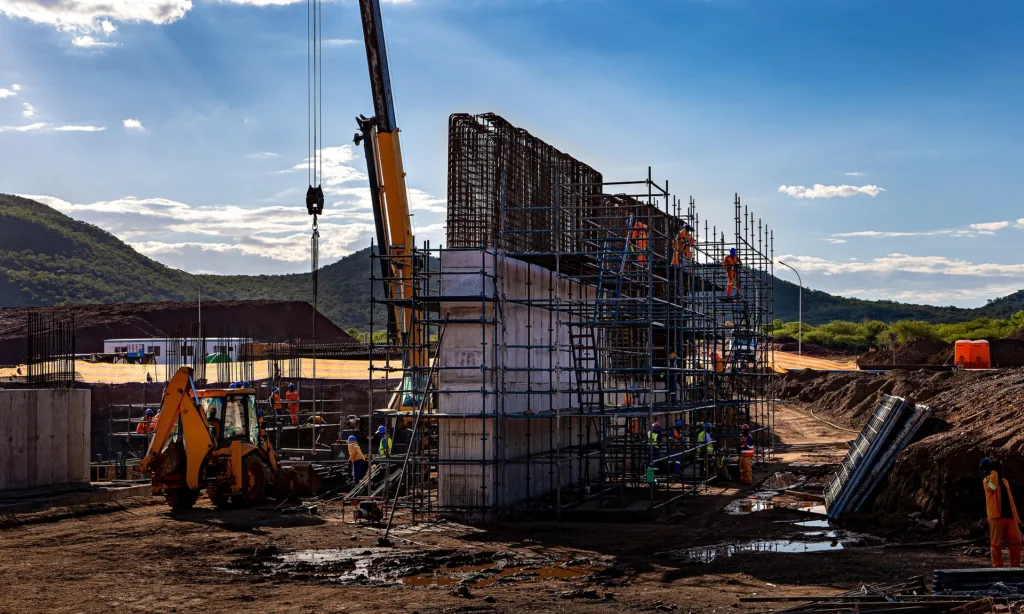
Ireland has the projects. It now needs the people to deliver them
Ireland’s construction pipeline represents an extraordinary opportunity. It can improve housing, transport, energy security, regional development and the country’s attractiveness to international investors. Yet capital investment does not build a motorway, tunnel, substation or data centre by itself. People do.
Companies that wait until contracts are awarded before addressing labour and supply-chain requirements will already be behind. The organisations best placed to succeed will be those that map their skills needs early, secure critical materials in advance and build a recruitment strategy that combines Irish talent with carefully selected international workers.
Aureol Global Connections helps construction and engineering employers build that international talent pipeline. Through targeted overseas recruitment, practical candidate testing and support throughout mobilisation, we help businesses secure the skilled people required to turn ambitious plans into completed projects. Ireland’s next chapter is ready to be built. The challenge now is ensuring that the right workforce is ready to build it.
If you’re looking to plan ahead and get the workforce your business needs to achieve its project goals or for any other reason then get in touch here.

